
Scotts Bluff County Court Records After a Jail Arrest
The local pathway is arrest, admission at the Scotts Bluff County Detention Center, prosecutor review, and then a court case if charges are filed. The detention research identifies the jail at 2522 7th Street in Gering, operated through the Scotts Bluff County Sheriff's Office under Sheriff Mark Overman. The booking process can include search, fingerprinting, photographing, medical screening, property inventory, and classification before the person appears on the public roster or moves to a first court setting.
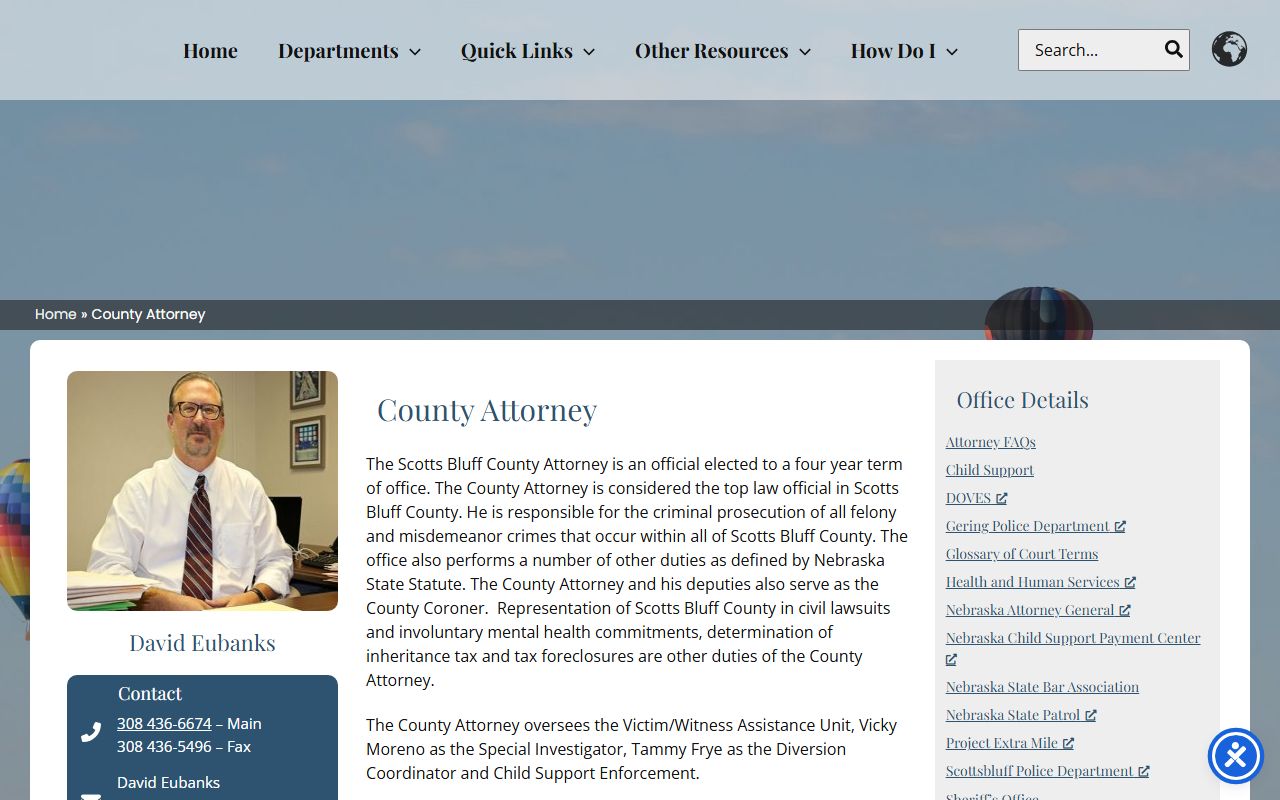
The formal court record is controlled by the filed case, not by the jail table. Scotts Bluff County Attorney David Eubanks is listed by the county as the elected county attorney, and the County Attorney's Office prosecutes felony and misdemeanor crimes occurring in Scotts Bluff County. County sources also say charges are filed on behalf of victims and can only be dropped by the County Attorney's Office. For custody status and the list-level booking record, use Scotts Bluff County jail inmate records. For booking-photo questions, use Scotts Bluff County jail mugshots. For the court side, use the county and district court offices or Nebraska JUSTICE.
The county attorney page at https://scottsbluffcountyne.gov/attorney-county/ identifies the prosecuting office and its duties. The county court page at https://scottsbluffcountyne.gov/court-county/ lists Scotts Bluff County Court contacts. The district court page at https://scottsbluffcountyne.gov/district-court/ explains that the Clerk of District Court is custodian of filings in district court, including criminal cases.
The county's County Attorney source page is the local reference for David Eubanks, the prosecutor's duties, and office contact information.
County Attorney, County Court, and District Court
The County Attorney's Office is at the Scotts Bluff County courthouse, top level, 1725 10th Street, Gering, NE 69341. The main phone is 308-436-6674, the fax is 308-436-5496, the office email listed in the research is countyattorney@scottsbluffcountyne.gov, and David Eubanks is listed at dave.eubanks@scottsbluffcountyne.gov. Deputy county attorneys named in the research are Helen Winston and Paul Payne. The same office also oversees victim/witness assistance, diversion, special investigator functions, child support enforcement, and certain civil county duties.
County Court is also at 1725 10th Street, Gering, NE 69341. The county page identifies it as part of the 12th Judicial District and lists 308-436-6648 as the main number, 308-436-6782 as fax, and office hours Monday through Friday, 7:30 a.m. to 4:30 p.m., open through lunch and closed weekends and holidays. The attorney FAQ gives 308-436-6650 for County Court case-date questions.
District Court and the District Court Clerk share the courthouse address. The phone directory lists District Court main at 308-436-6660, District Court Clerk at 308-436-6641, and fax at 308-436-6759. Felony cases and other district-court criminal filings should be checked with that clerk or through the statewide case-search system when public access is available.
How to Find Scotts Bluff County Court Records After an Arrest
Nebraska's online court case search is the JUSTICE One-Time Case Search at https://www.nebraska.gov/justicecc/ccname.cgi. The service covers criminal, civil, traffic, juvenile, and probate cases filed in all 93 Nebraska county and district courts. It is not the jail roster, and it does not replace direct confirmation with the court when a hearing, bond condition, or warrant must be verified.
- Start with the court pathway, not the booking row. Confirm that the person was booked locally through the Zuercher inmate route or the Detention Center, then check whether a case has been filed.
- Open Nebraska JUSTICE and accept the terms and conditions to begin the one-time search workflow.
- Search by party name. The JUSTICE notice says searches are performed using party name, not witness name.
- Use narrowing criteria only when the name search returns more than 30 cases, because the service warns against over-narrowing too early.
- Review the case detail, party listing, costs, payments, register of actions, and any public document images that are available for the case.
The JUSTICE search costs $17 per search, and no-result searches still require payment. The service states that there is a 24-hour lag between when a new case is entered and when it appears online. A completed search gives access to case details for three calendar days. That timing matters after a new jail arrest because the person can be booked, bonded, or held before the court case becomes visible through the statewide portal.
The Nebraska Judicial Branch court-record resource at https://nebraskajudicial.gov/self-help/court-records is another statewide starting point for court-record self-help information, while local clerk offices remain the most direct source for county-specific court dates, filed documents, and clerk procedures.
| JUSTICE Field or Notice | Type | Required | Scotts Bluff Use |
|---|---|---|---|
| Terms and Conditions checkbox | Checkbox | Yes | Must be accepted before the one-time search begins. |
| Begin Search | Button | Yes | Starts the paid case-search workflow. |
| Party name search | Name workflow | Yes | Use defendant name; the page says not to search by witness name. |
| Narrowing criteria | Optional filters | No | Use after a broad name search returns more than 30 cases. |
| Fee and access window | Payment notice | Yes | $17 per search, no refund for no result, three calendar days of detail access. |
Charging Documents After an Arrest: Complaint, Information, and Indictment
A booking record begins at the jail, but a charging document begins the public court case. The prosecutor may file a complaint or information after reviewing the facts, law-enforcement reports, witness information, criminal-history issues, and any bond or hold questions. An indictment is a grand-jury charging document and is less common in routine local case flow. The filed document controls the charge record that appears in court, even when the original booking description used different wording.
| Charging Document | Filed By | Common Use | What to Check |
|---|---|---|---|
| Complaint | Prosecutor or authorized complaint process | Many county-court criminal cases and initial filings | Charge text, statute, probable-cause basis, first appearance setting. |
| Information | County Attorney | Many felony-level district-court prosecutions after the required process | Final filed counts, amendments, arraignment status, plea entries. |
| Indictment | Grand jury | Serious or less routine criminal matters | Indicted counts, court assignment, warrant or summons status. |
Charge Status in Court Records After an Arrest
Charge status can change after a Scotts Bluff County arrest. A jail record may show the arrest date and custody status while the court file later shows a pending complaint, an amended charge, a dismissed count, a plea, or a sentence. Public users should read each count separately rather than assuming that one outcome applies to the entire case.
| Status | What It Means | Why It Matters |
|---|---|---|
| Pending | The charge has been filed and remains unresolved. | The person is presumed not convicted unless and until the case reaches a conviction or plea outcome. |
| Amended or Reduced | The filed count changed, often by prosecutor action, plea agreement, or court order. | The original booking charge may no longer match the active court charge. |
| Dismissed | The count was terminated without conviction on that count. | Other counts may remain active, and criminal-history redaction rules may need separate review. |
| Convicted | A guilty plea, no contest plea accepted as conviction, or verdict resulted in conviction. | Sentencing, fines, jail credit, probation, or transfer to NDCS may follow. |
| No Charges Filed | The prosecutor did not file a court case from the arrest event. | Nebraska criminal-history redaction rules may become relevant after the applicable waiting period. |
Bond and Release After an Arrest
Bond is accepted 24/7 at the Scotts Bluff County Detention Center, according to the detention FAQ. During normal office hours, a person posting bond checks in with the receptionist. Outside normal business hours, the waiting-area intercom connects the visitor with an officer. The county page says a valid driver's license must be presented. It does not publish accepted payment types, online bond options, or a bond-fee schedule, so payment method and exact amount should be confirmed before travel.
The public inmate list does not display bond amounts. The warrant portal may show a bond amount for warrant records, but that is not a complete bond record for every inmate or every case. A court order, warrant, first appearance, or later hearing can change release conditions. A person can also remain in custody after money is posted if another hold exists, such as another county warrant, probation or parole hold, USMS hold, ICE detainer or request, or sentence commitment.
| Bond Type | How It Works |
|---|---|
| Cash Bond | Cash or court-approved funds are posted in the amount required by court order or schedule. |
| Surety Bond | A licensed bonding agent may post surety when allowed by the court and Nebraska procedure. |
| Personal Recognizance | Release is based on a promise to appear and comply with conditions, without posting the full cash amount. |
| Property or Security Bond | Property or other security may be used only when ordered or accepted by the court. |
| No-Bond Hold | Release is not available until the court or holding authority changes the order. |
Warrants That Lead to an Arrest
Scotts Bluff County uses the countywide Zuercher warrant portal at https://scottsbluff-so-ne.zuercherportal.com/#/warrants. The Scottsbluff Police Community Engagement Portal says WARRANTS lists all current warrants. The inspected portal configuration supported search by name, DOB or age range, charge, and bond amount, and displayed list-level fields including name, age, bond amount, charge, and optional comments. The research inspection found a broad query returning 549 warrant records, but individual warrant names should be verified through the official portal or the Sheriff's Warrants line.
The Sheriff's Warrants number from the county phone directory is 308-436-6668 ext. 5894. Direct confirmation is important because portal information may lag, bond can change, and appearing in person on an active warrant can result in arrest. County Court bench warrants may also require court contact, and district-court warrants may require the District Court Clerk or judge-specific instructions.
Charges vs. Convictions
A charge is an accusation filed in court. A conviction is a legal outcome after a plea or verdict. The distinction is essential when reading Scotts Bluff County court records after an arrest because the existence of a charge does not mean guilt, and a booking photo or roster entry does not prove a conviction.
| Charge | Conviction | |
|---|---|---|
| Stage | Accusation filed by the prosecutor or through court process. | Final outcome after guilty plea, accepted plea, or guilty verdict. |
| Proof Level | Based on probable cause and charging standards. | Requires proof beyond a reasonable doubt or a legally accepted plea. |
| Public Record | Often public unless sealed, juvenile, or otherwise restricted. | Often public unless sealed, set aside, restricted, or affected by another statute. |
| Practical Effect | May affect bond, hearings, and case conditions. | May affect sentencing, probation, fines, jail credit, NDCS transfer, and criminal history. |
Police Reports, Evidence, and Pro Se Discovery
The County Attorney FAQ at https://scottsbluffcountyne.gov/attorney-county/attorney-faqs/ gives a specific local rule for defendants seeking copies of police reports or evidence tied to pending charges. A pro se defendant must request the materials in person, present photo identification, and can obtain the report only for self after appearing in court for arraignment and declining counsel. The listed charge is $0.25 per page. A represented defendant should work through the attorney, and a court order may be needed.
That process is different from a general public-records request. Discovery materials can include nonpublic, victim-sensitive, investigatory, or court-controlled information. Public users looking for the filed charge should start with JUSTICE or the clerk. Defendants looking for evidence in a pending case should follow the County Attorney FAQ and any court order in the case.
Sealed vs. Expunged Arrest Records
Nebraska public-record and criminal-history rules use specific statutory categories rather than a simple rule that every arrest disappears after a dismissal. The Nebraska State Patrol criminal-history guidance applies redaction to certain public criminal-history records after events such as no charges after one year, diversion-related no charges after two years, and dismissal or acquittal when statutory conditions apply. That guidance does not automatically prove that a jail roster image, court index entry, or third-party copy has been removed.
| Sealed or Restricted | Expunged or Redacted | |
|---|---|---|
| Visibility | Public access may be limited by court order, juvenile law, or another statute. | Public criminal-history dissemination may omit or redact qualifying arrest information. |
| Record Holder | Court, clerk, law enforcement, or jail custodian may each have different obligations. | State Patrol criminal-history records follow Neb. Rev. Stat. 29-3523 and related guidance. |
| Local Step | Contact the court of record and the clerk about the case file. | Contact the State Patrol for RAP sheet questions and the Sheriff records unit for local correction questions. |
| Limit | Restricted access does not always erase internal law-enforcement records. | Redaction from one system does not guarantee removal from every public portal or copy. |
Public Access Limits for Court Records After an Arrest
Nebraska's public-record framework starts with Neb. Rev. Stat. 84-712 and 84-712.01. Those statutes generally allow interested persons to inspect and obtain copies of public records belonging to state, county, city, political subdivision, or tax-supported agencies unless another statute makes the record nonpublic. Neb. Rev. Stat. 84-712.03 addresses denial and response obligations. Criminal-history dissemination is controlled separately by Neb. Rev. Stat. 29-3523, which is why a State Patrol criminal-history report may not match every booking or court event visible somewhere else.
Juvenile matters, sealed records, victim-sensitive materials, ongoing investigations, and records restricted by court order may not be available to the public. The Scotts Bluff County jail register requirement under Neb. Rev. Stat. 47-106 does not mean every internal jail field must appear online. The public roster inspected for Scotts Bluff County displayed name, mugshot, arrest date, and release date, while charges, bond, booking number, and court dates were not exposed in the public inmate list template.
Important: Scotts Bluff County Inmate Population is not a consumer reporting agency under the Fair Credit Reporting Act. Do not use these records for credit, employment, housing, insurance, or any FCRA-regulated decision.